Soon afterward, Francis also removed his disciple from the monastery of Sant’Angelo and assigned her to the cloister of San Damiano.
In the almost ruined church of San Damiano, the Crucifix had spoken to Francis, saying, “Francis, go and repair my church, which is all in ruins and falling apart.”
The young man had thought that the command referred to the material walls. So he repaired them with stones and mortar. Then he understood that Christ’s command referred to something else, and that the Church was the very body of Jesus, agonizing on the Cross.
He cast aside all his wealth, renounced every ambition, and made himself willingly humble and poor. He espoused—as he put it—Lady Poverty.
Even after Francis had restored it with his inexperienced hands, San Damiano remained a poor place. The church resembled that of Santa Maria degli Angeli: small and dark, with a pointed vault. The surrounding buildings could serve as a convent for a few women, and above all for poor women.
Thus the Second Franciscan Order, the women’s order, was born at San Damiano, and was called the “Poor Ladies.”
“Poor ladies,” and nothing more, with no other name.
“Poor ladies,” who lived on alms, ate bread they had begged for, and fasted on most days.
Francis had willingly espoused poverty. Clare wished to be poverty itself, poverty incarnate.
In this way she joined Francis in absolute poverty, willingly embraced and pursued for love of the great, poor Master and Lord of the universe, Jesus.
The old church, dominated by the great Crucifix, was adorned with bunches of wildflowers.
Behind the apse was the choir of the “Poor Ladies,” made of rough boards, not even planed. Set into the stone floor was a post around which the rudimentary lectern revolved, lit by an oil lamp.
A barred window opened onto the church, and through its iron bars, like prisoners, the Poor Ladies received Communion.
From a small cloister, supported by pillars without capitals, one passed into the low, dark refectory. Rough tables were arranged around the room, without tablecloths. There, giving thanks to the Lord, the “Poor Ladies” ate what they received as alms.
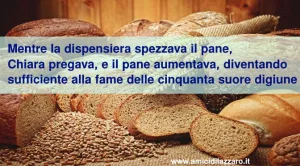
Clare preferred little chunks of bread.
A whole loaf seemed too great a luxury to her. She lived on leftovers, asking for scraps. A whole loaf, on the other hand, was a complete gift.
A single dormitory upstairs housed the “Poor Ladies.” A bare, cold room beneath the roof beams. Their bed was a bundle of twigs; their pillow, a small log. Their sheets were of coarse hemp, and their blankets were pieced together from scraps.
Bare feet in every season; coarse garments tied with rope; their heads shaved and covered with one white cloth and one black cloth.
Beneath her garments, Clare wore a hairshirt made of pigskin, with the bristles against her flesh. They were “Poor Ladies” as poor as could be. In San Damiano, Clare sought to be foremost in poverty. There was to be no woman in the world poorer than she.
Nothing was hers; everything was borrowed; every gift was freely given.
Poverty freely chosen, not merely accepted, but desired as the most coveted of privileges. A joyful poverty, content with itself; a cheerful, festive poverty, neither repulsive nor distressing.
A poverty without thorns, which blossomed like the rose: it smiled and rejoiced beneath the sun of Grace.
No lament, no sigh rose from San Damiano. Poverty in that hovel caused no sorrow; want at that table made no one grow weak; hardship in those beds brought no torment. Clare wished to be poverty itself. Thus, the poorer she became, the more content she was; the poorer she felt, the more joyful she was.
from The Little Flowers of Saint Clare
translated by Amici di Lazzaro
© Tutti i diritti riservati. Riproduzione consentita solo chiedendo permesso a info@amicidilazzaro.it
(non verrà concesso a siti con pubblicità/ads o per usi commerciali)
© All rights reserved. Reproduction allowed only with permission from info@amicidilazzaro.it
(it will not be granted to sites with advertising/ads or for commercial uses)


