Dear Secretariat and Members of the UN Human Rights Committee (HRC),
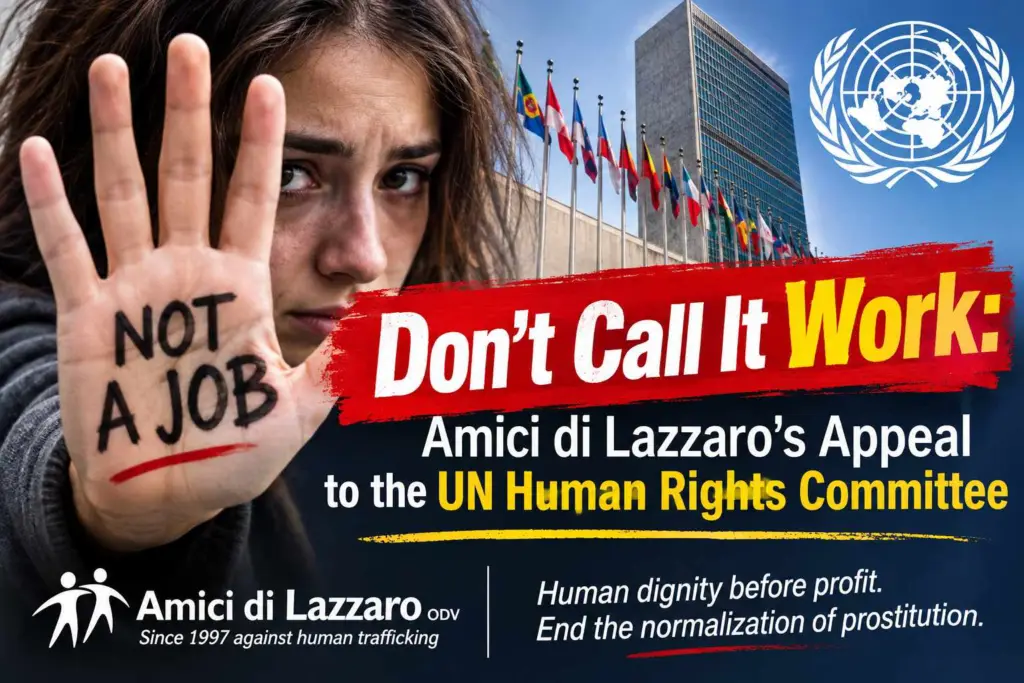
I am writing on behalf of Amici di Lazzaro ODV, an Italian non-profit organisation that has been working since 1997 to combat human trafficking, sexual exploitation and all forms of exploitation of vulnerable people. Through our work, we stand alongside victims of trafficking and exploitation, advocating for their dignity, freedom and fundamental human rights.
I am writing with great concern that the HRC Committee is still deliberating on whether to include the terminology and ideology of “sex work” and “sex worker” in the draft text of your General Comment No. 38 on freedom of association (Article 22).
Adopting this language legitimizes the system of prostitution and the sex trade in general, runs counter to international laws and human rights instruments, and creates a clear conflict with established jurisprudence across the UN system, most notably the 1949 Convention for the Suppression of the Traffic in Persons and of the Exploitation of the Prostitution of Others, Article 6 of CEDAW, and CEDAW Committee’s General Recommendation No. 38 (2020).
The CEDAW Committee’s General Recommendation No. 35 (2017) also reaffirms that gender-based violence encompasses systems of sexual exploitation. Decoupling prostitution from its inherent structural inequalities by classifying it as “work” undermines victim protections and weakens the international framework that addresses violence against women and girls.
From our longstanding experience in combating human trafficking and sexual exploitation, we believe that the terminology used by international human rights bodies is not merely a matter of words. Language shapes policies, influences legal frameworks and, above all, has real consequences for the recognition and protection of victims. Referring to prostitution as “sex work” risks obscuring the coercion, exploitation, gender inequality and vulnerability that are so often at its core. We believe that human dignity and the protection of those who are exploited must remain central to the Committee’s approach.
Thank you for your urgent consideration of refraining from or removing the terms “sex worker” and “sex work” from Paragraph 9 and all subsequent drafts of General Comment No. 38.
We sincerely hope that the Human Rights Committee will uphold the principles of human dignity, equality and protection from exploitation, ensuring that its language remains consistent with the international human rights framework and the obligation to protect those most vulnerable to trafficking and sexual exploitation.
Yours sincerely,
Paolo Botti
President
Amici di Lazzaro ODV
Italy


