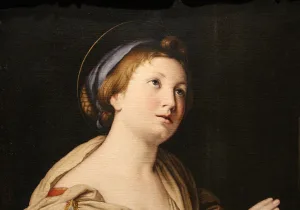
Saint Cecilia, who died in Rome on 22 November 230, was a Roman noblewoman who converted to Christianity, a virgin and Christian martyr. She is widely venerated because Cecilia is the patron saint of music, instrumentalists and singers. Catholics and Orthodox Christians commemorate her on 22 November. Apart from the Blessed Virgin Mary, she is one of only seven female saints commemorated by name in the Canon of the Mass.
According to tradition, Cecilia was betrothed to the young pagan Valerian. On their wedding night, Cecilia revealed to her bridegroom that an angel of God guarded her virginity and invited him to convert. That very night, Valerian went to the Appian Way, where, at the third milestone, he met Saint Pope Urban. Urban instructed and baptised Valerian, who then returned home and saw Cecilia prostrate in prayer, with the angel who had always watched over her.
Suspicious, he asked for proof that the young man was indeed an angel. The angel then made two crowns of flowers appear and placed them on the heads of the newlyweds. Having become a believer, Valerian prayed that his brother Tiburtius might also receive the same grace, and so it came to pass. The two brothers, now converts, devoted themselves to burying the victims of persecution. Denounced (for burying Christians was forbidden), they were condemned to beheading and were buried in the Catacombs of Praetextatus.
After their deaths, Saint Cecilia too was summoned before the judge Almachius, who ordered her death. The executioners, not daring to carry out the sentence in public, tried to suffocate her with the vapours in the bathhouse (calidarium) of her home, heated to an extremely high temperature. But a miracle took place: after a day and a night, Cecilia was found still alive, enveloped in a heavenly dew, a sign of divine protection.
A lictor (a public official in ancient Rome charged with accompanying and protecting magistrates vested with imperium, such as consuls and praetors), sent to behead her, struck her neck three times but could not sever it. Despite her wound, Cecilia lived for three more days. When Pope Urban I came to visit her, the dying maiden bequeathed her house to him, asking that it be turned into a church.
In 821, during the pontificate of Paschal I, the church that had been built was consecrated to the holy martyr. The body of the saint, still intact after five hundred years, was translated from the Catacombs of Saint Callixtus (where the crypt that once housed her body can still be visited) to the church, her former home, together with the martyrs Valerian, Tiburtius and Maximus. Paschal I also had the body of Saint Urban brought there.
The Legenda Aurea recounts that Pope Urban I, who had converted her husband Valerian and witnessed her martyrdom, «buried Cecilia’s body among those of the bishops and consecrated her house, turning it into a church, just as she had asked him».
In 1599, during restoration work on the Basilica of Saint Cecilia in Trastevere, Cardinal Paolo Emilio Sfondrati had the sarcophagus containing the saint’s relics opened.
According to contemporary accounts, the body was found in a remarkably natural position, as if Cecilia were still asleep, with her head turned to one side and her fingers extended in a particular gesture. That same year, the sculptor Stefano Maderno created a celebrated marble statue depicting the very position in which, according to the account, the martyr’s body was found. The work is still located beneath the basilica’s high altar.
Saint Cecilia is the patron saint of music, because it is said that during the celebration of her wedding, while the musical instruments were playing, Cecilia sang in her heart to God: «Cantantibus organis, Caecilia in corde suo soli Domino decantabat», «While the musical instruments were playing, Cecilia sang in her heart to the Lord alone» (an episode recounted in the Passio Sanctae Caeciliae, an ancient account of her martyrdom).
Over the centuries, this expression has been interpreted as a direct reference to music. For this reason, Cecilia became the patron saint of musicians, singers and instrumentalists.
Saint Cecilia’s feast day is 22 November.
Paolo Botti
© Tutti i diritti riservati. Riproduzione consentita solo chiedendo permesso a info@amicidilazzaro.it
(non verrà concesso a siti con pubblicità/ads o per usi commerciali)
© All rights reserved. Reproduction allowed only with permission from info@amicidilazzaro.it
(it will not be granted to sites with advertising/ads or for commercial uses)


