To become true consecrated women, we must fall ever more deeply in love with Jesus. Let us love Him with all our faculties, in body and spirit. Let no one say that a woman in the world loves her husband more than we love Jesus. This is our right and our privilege, because, as women, we were created to love and to be loved.
The more deeply a soul is captivated by love, the more it identifies with all humanity, because love leads it to enter into every suffering, wherever there are souls to be saved. As missionaries and consecrated women, we must put love first in our lives. Our vows, our apostolate, and our community life are all fruits of our loving union with Jesus.
The vow
The vow of chastity is not simply a list of prohibitions: it is love… It is a giving and receiving: I give myself to God and receive God. God becomes mine, and I become His. That is why, through the vow of chastity, I consecrate myself entirely to Him.
Faithfulness
In Rome, a woman told me her story. On the day she left the church after getting married, she fell in love with another man. For twenty-six years, she lived with that love for that man.
“But I had given my word to this man [my husband] and, to be faithful to God and to the man to whom I had given my word, I had to say ‘no’ to him [the other man]. Every day was a veritable Calvary. Every time he comes to Rome: ‘no,’ even though I feel no love for the man I married.”
This woman said: “Death, yes; sin, no.” Twenty-five [years] multiplied by three hundred and sixty-five [days] and by sixty minutes!
Now I am speaking of a Christian woman. Today she loves her husband with an undivided love. I have made my vows to God, and only death can separate me from Him. This is chastity.
Chastity
By the vow of chastity, I renounce the married state, having a home, and founding a family, for the love of God. We Catholics understand this readily, but non-Catholics cannot understand how a woman can live without marrying. In their eyes, it is something profoundly unnatural; yet they admire it, without understanding what moves us to renounce a right that belongs to us.
By the vow of chastity, I not only renounce married life, but also consecrate to God the free use of my interior and exterior acts and my affections. In conscience, I cannot love a creature with the love of a woman for a man. I no longer have the right to reserve for any other creature that affection which belongs to God…
Freedom
People who live in the world think that the vow of chastity makes us inhuman, that it turns us into beings of stone, devoid of feeling. Each one of us can testify that this is not so.
It is precisely the vow of chastity that gives us the freedom to love everyone, rather than to become mothers of three or four children. A married woman can love one man; we can love the whole world in God.
The vow of chastity does not impoverish us: it enables us to live fully, if we observe it faithfully and do not limit ourselves to regarding it merely as a set of prohibitions.
The vow of chastity is not simply a list of prohibitions: it is love. That is why we can look at each person and say: “I love everyone.”
Our Constitutions tell us that we must love one another with intense love. We can do so because we love God.
It is a giving and receiving: I give myself to God and receive God. God becomes mine, and I become His. That is why, through the vow of chastity, I consecrate myself entirely to Him.
And when we stoop to indulge impure thoughts, we throw away precious stones to gather mud. In our spiritual life, we possess God, who is almighty and infinitely great, yet we stoop to a creature.
It is inconceivable that we should turn away from Almighty God to concern ourselves with a creature, however good that creature may be (referring to chastity). It is like a little child who, instead of choosing sweets, turns away to eat the plaster from a wall or even mud.
We must look within ourselves honestly, because the desire to stoop to that “mud” is present in each one of us; but some give in to it, while others turn away from it.
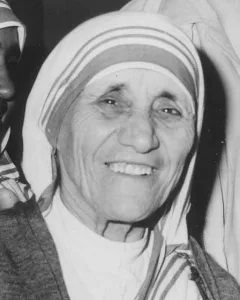
Mother Teresa of Calcutta
Saint Teresa of Calcutta (1910–1997) devoted her life to loving Jesus through service to the poorest and most vulnerable. She founded the Missionaries of Charity, a religious congregation now present throughout the world, whose members embrace a life of poverty and devote themselves to caring for those most in need wherever they serve. Through her witness, she showed that true chastity and faithfulness are rooted in an undivided love for God, made manifest in selfless love and service to every human being. Her liturgical memorial is celebrated on September 5.